Many journeys through Vietnam begin in Hanoi, and many first notebook pages begin at Hoan Kiem Lake. The lake sits at the heart of the old city, with the tangle of the Old Quarter to its north and the broader avenues of the French-built quarter to its south and east. It is small enough to walk around in well under an hour, and it changes completely between five in the morning and ten at night.
This page follows a simple plan for a first day: the lake at dawn, the temple on its island, the Old Quarter through the late morning, and back to the water in the evening. It is a plan built around stopping often to write.
The lake at dawn
Hanoi gets up early. Around first light, the paths around Hoan Kiem fill with people exercising: groups doing slow stretches, couples dancing to music from small speakers, people running, walking backwards, or simply sitting on benches facing the water. It is one of the best hours anywhere in Vietnam to watch daily life, and nobody minds a quiet person with a notebook on a bench.
The name means lake of the returned sword. A well-known legend tells of a fifteenth-century king, Le Loi, who was given a magic sword to drive out invaders and later returned it to a golden turtle in the lake. A small tower stands on an islet in the southern part of the lake, the Turtle Tower, which has become a symbol of the city.
It is one of the best hours anywhere in Vietnam to watch daily life, and nobody minds a quiet person with a notebook on a bench.
The Huc bridge and Ngoc Son Temple
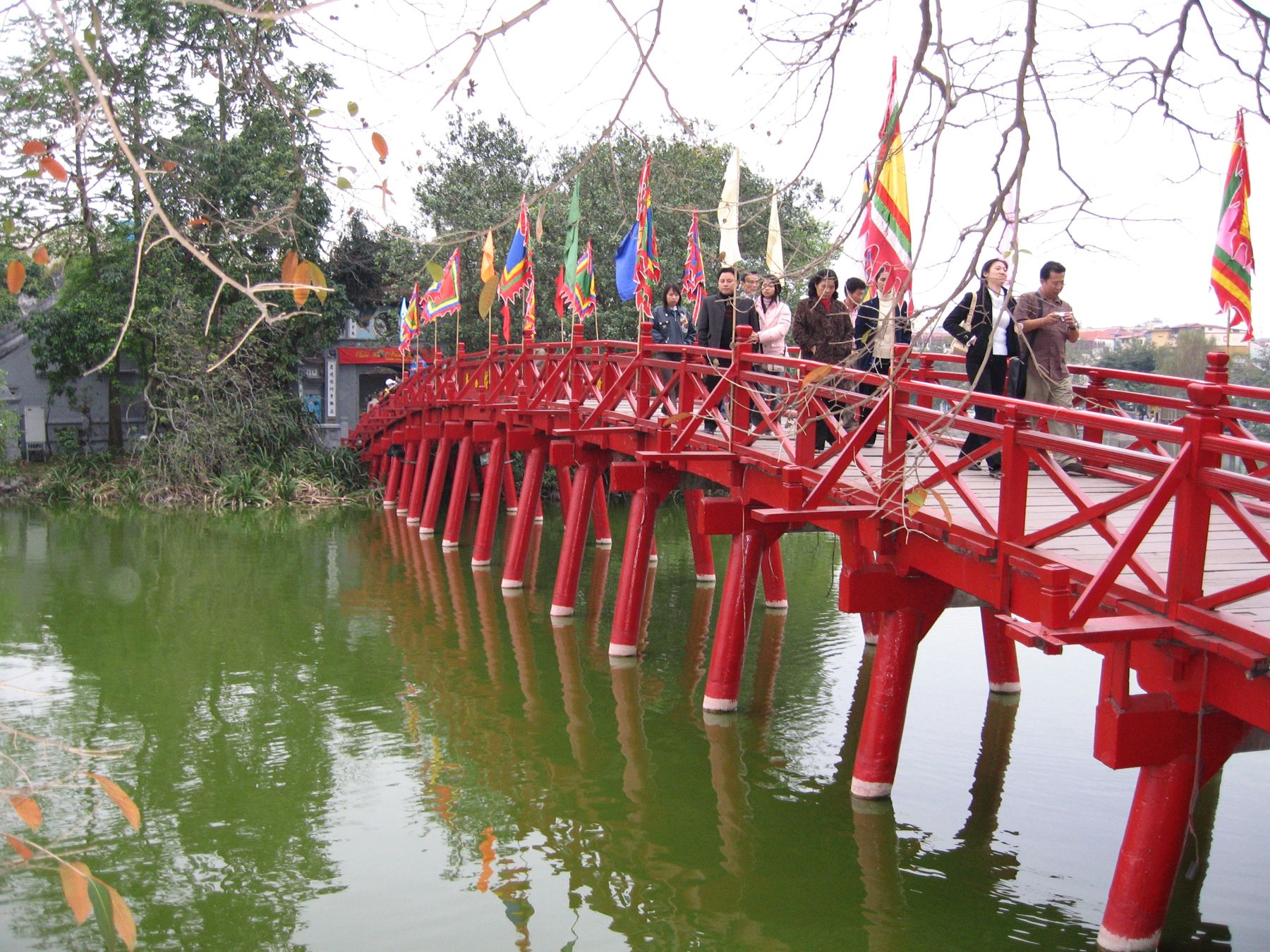
On the northern side of the lake, a bright red wooden bridge, the Huc bridge, arches out to a small island and Ngoc Son Temple, the Temple of the Jade Mountain. The temple honours a scholar, a military hero of the thirteenth century and a patron of physicians, among others, and it is a calm place in the middle of a loud city.
The bridge is the photograph everyone takes. For a notebook, it is better to stand at the shore end and write what crosses it: school groups, families, couples in wedding clothes, people carrying offerings. A rough drawing of the curve of the bridge against the trees takes a minute and will bring the place back better than any picture.
turn to page 4Ho Chi Minh City: the post office, the market, the trafficThe guild streets
North of the lake lies the Old Quarter, a grid of narrow streets that grew up as a district of craft guilds. Many street names still begin with Hang, meaning goods or merchandise, followed by what was once sold there: silk, silver, paper, tin, sugar, salt and more. Some streets still specialise; others have moved on to souvenirs and clothes.
The buildings are typical tube houses, very narrow at the front and very deep, with shops at street level. Look up as well as along: balconies, shutters, plants, wiring and roof terraces fill the view above the shopfronts. The pavements are used for parking, cooking, eating and working, which leaves little room to walk, so expect to share the road with scooters at a slow pace.
The best way to write the Old Quarter is from a low plastic stool on the pavement, the kind set out in front of countless food stalls and small coffee places. Order something, sit for half an hour and write down everything that passes: deliveries balanced on scooters, sellers carrying baskets on shoulder poles, children going home from school. The notebook page has a short method for days like this.
Evenings and seasons
On weekend evenings, streets around the lake have in recent years been closed to traffic, and families walk, play games and listen to street musicians where cars and scooters usually run. Arrangements can change, but if you are in Hanoi at the weekend it is worth walking down to the lake after dark to see.
Hanoi has a real winter. From about December to February it can be cool, grey and damp, and summer from about May to September is hot and humid with heavy rain. Autumn, roughly October and November, and spring, around March and April, are the most comfortable months for walking. Whatever the season, carry a pen that copes with humidity, and expect the streets to be at their quietest in the hour after dawn.
From Hanoi, the journey on these pages runs south to Hoi An on the Thu Bon River, by air to Da Nang or by train along the coast.
The other pages
Photographers and licences: picture owners.