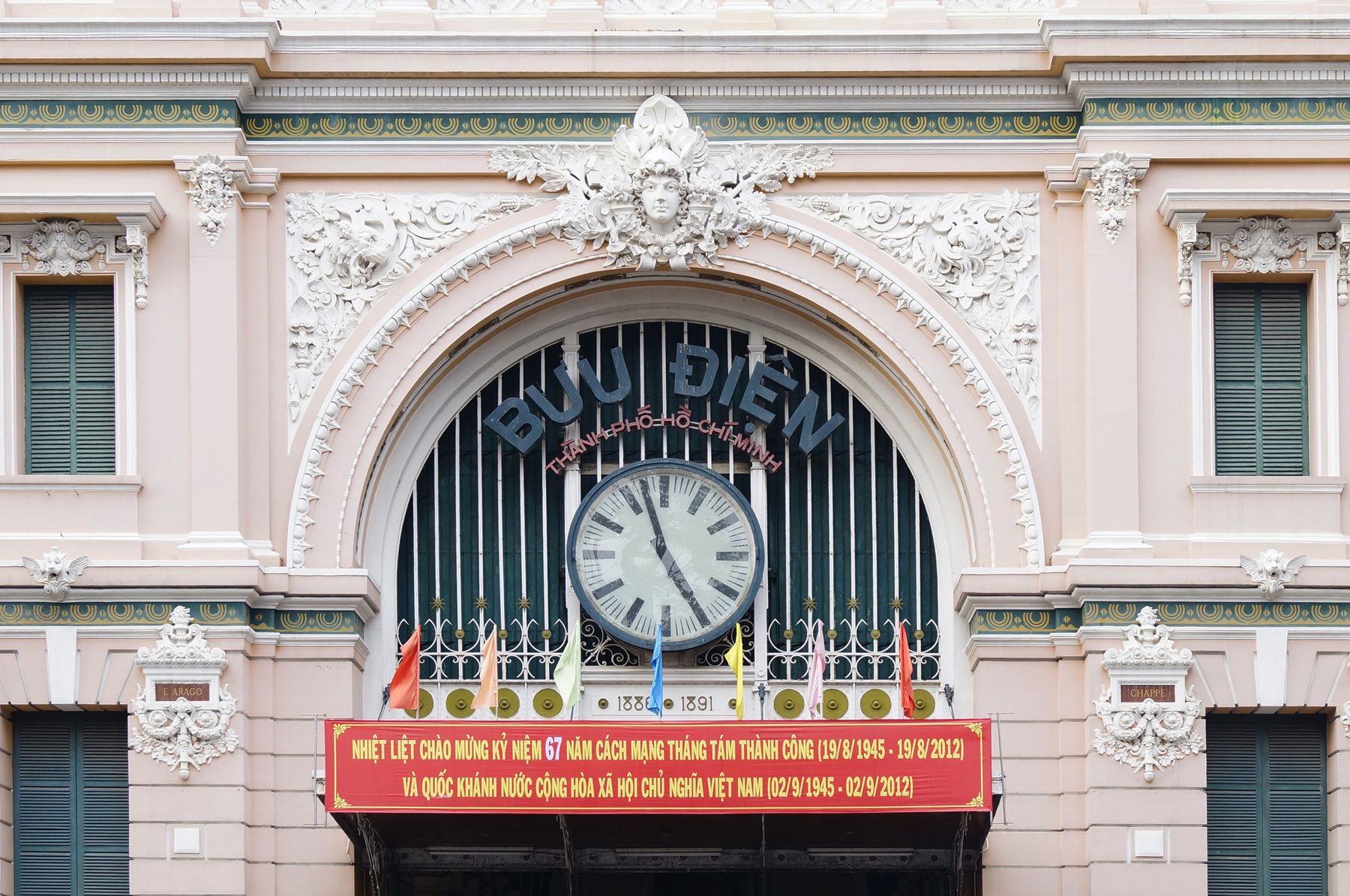
Ho Chi Minh City, still widely called Saigon, especially for its central district, is the end of the road for many journeys through Vietnam. After the quiet of Hoi An it can feel overwhelming. It is worth meeting it head on: the energy of the place, the sheer number of scooters, the food sold from every corner and the noise are exactly what a notebook is for.
The old colonial centre, in District 1, is walkable. Three places close together make a natural first day: the Central Post Office, the cathedral beside it and Ben Thanh Market a short walk south.
The Central Post Office
The Saigon Central Post Office was built in the late nineteenth century, when the city was the capital of French Cochinchina, and finished around 1891. The design is often linked with the firm of Gustave Eiffel, though the building's architect is usually given as Alfred Foulhoux. Whoever drew it, it is a grand hall under an arched iron and glass roof, with a large portrait of Ho Chi Minh at the far end and old painted maps on the walls.
It is still a working post office. You can buy stamps and send a postcard, which is a good excuse to sit at one of the wooden counters and write. Note the maps, the clocks and the ceiling, and the way sound carries in the long hall.
The cathedral next door
Across the small square stands Notre-Dame Cathedral Basilica of Saigon, built in the 1870s and 1880s with red bricks shipped from France and two bell towers. In recent years it has been under long restoration, so you may find scaffolding and limited access. Even from outside, it frames the square well, and the square itself is a good place to watch the city move.
turn to page 3Hoi An by the Thu Bon RiverBen Thanh Market
Ben Thanh Market, under its clock tower at the edge of District 1, is the city's best-known market. Inside, long aisles of stalls sell fabric, dried goods, coffee, kitchenware, souvenirs and cooked food. It is crowded, warm and noisy, and a good place to practise the list habit from the notebook page: ten things you saw, five smells, three words you heard repeated.
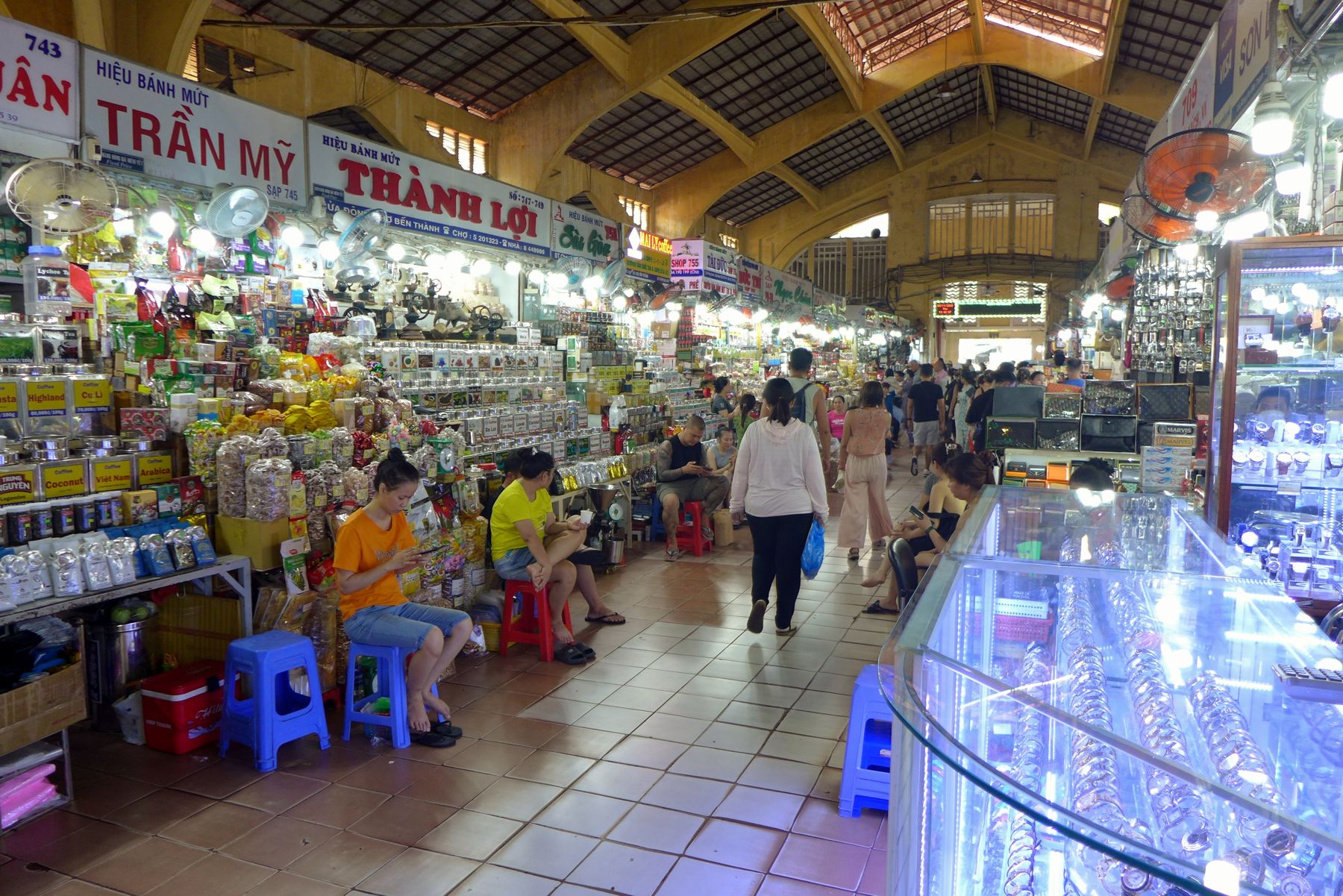
Go early in the day if you want to see the market at its most practical, when the food sellers are setting out and fewer visitors are in the aisles. Late in the afternoon the stalls around the edge start to close, and in the evening the streets beside the market fill with food sellers instead.
Prices are often open to bargaining in the market, and the amounts change, so this page does not give any. Bargain politely and keep your belongings close, as you would in any busy market.
Crossing the street
The thing every visitor writes about in Ho Chi Minh City is the traffic. Scooters fill the streets in every direction, and crossing can look impossible. The usual advice is simple: walk at a slow, steady pace, do not stop or run, and let the traffic flow around you. Using pedestrian crossings and crossing alongside local people helps.
Write about it as it happens. Note what people carry on scooters, how families fit four to a seat, and how the flow changes when it rains, which in the wet months, roughly May to November, often means a heavy downpour in the afternoon. The drier months from about December to March are the most comfortable for walking.
If your journey started in the north, this is a good moment to read back through your Hanoi pages and notice how different two cities in one country can sound.
The other pages
Photographers and licences: picture owners.